Walk into any home décor store,
scroll through any marketplace, and you'll find rugs labelled 'handmade'
sitting next to ones that cost a fraction of the price. Both look similar at a
glance. Both have pile. Both have pattern. So what exactly are you paying
forand why does it matter?
The
answer lies in three fundamentally different methods of making a rug:
hand-knotting, hand-tufting, and machine manufacturing. Each produces a
different product, with a different lifespan, a different feel underfoot, and a
very different story behind it. Here is an honest breakdown of all three, so
you can buy with confidence, not just with hope.
Method 1: Hand-Knotted
What it is
Hand-knotting
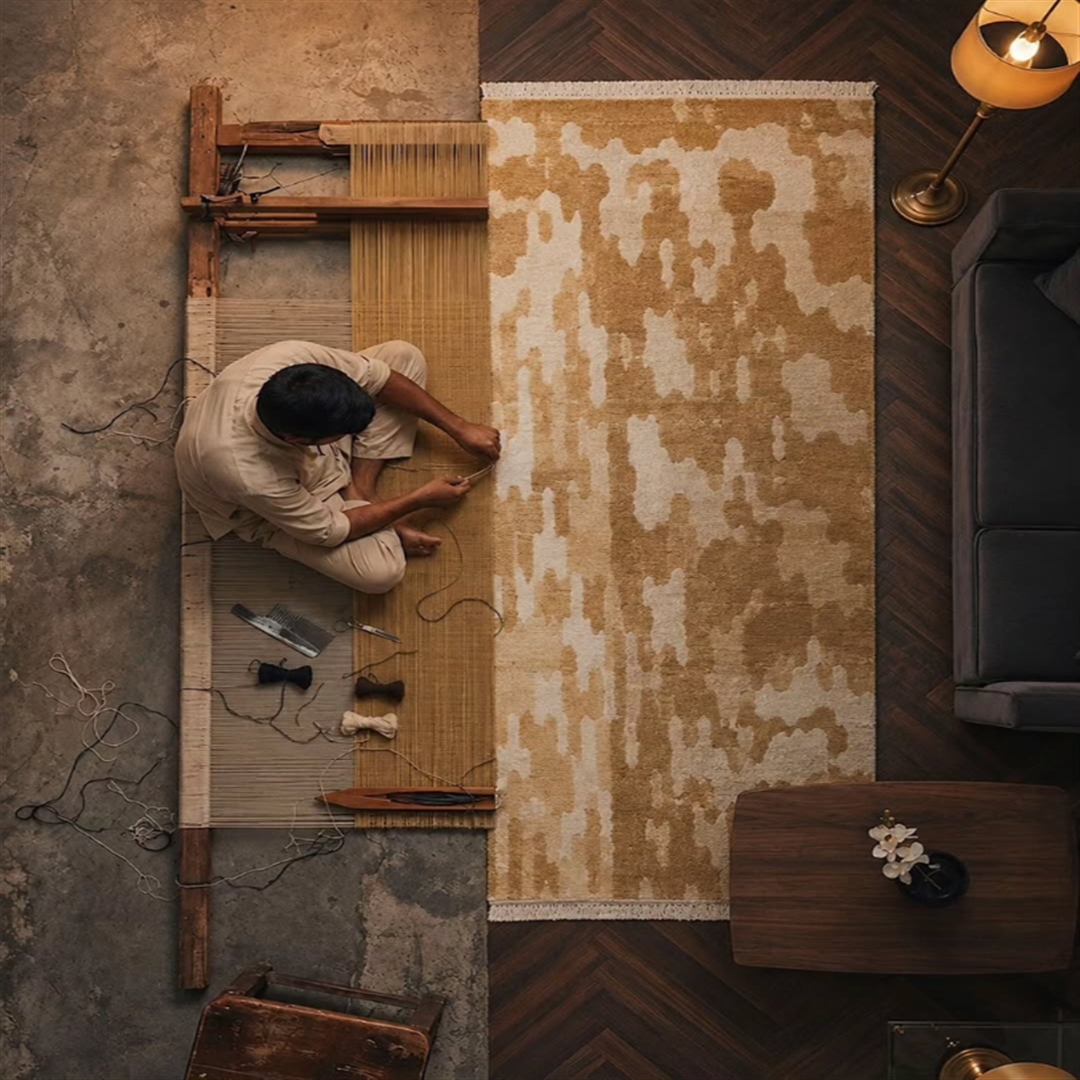
is the oldest and most labour-intensive method of rug-making in existence. An
artisan sits at a vertical loom and ties individual knots one at a time around
pairs of warp threads. Each knot is cut, compacted, and the process is repeated
thousands of times across the width and length of the rug.
A
single 5x8 ft hand-knotted rug typically contains between 40,000 and 1,000,000
knots depending on the knot density measured in KPSI, or knots per square inch.
A skilled artisan in Mirzapur can tie roughly 8,000–10,000 knots per day. That
means a medium-density rug of this size takes weeks, sometimes months, to
complete.
How to identify it
Flip
the rug over. If it is hand-knotted, you will see:
•
Individual
knots clearly visible on the back
•
The pattern
mirrored on the reverse, slightly less defined but recognisable
•
No latex, no
canvas backing, no glue
•
Slight
irregularities in the pile height, signs of a human hand, not a machine
Lifespan & durability
A
well-made hand-knotted rug does not just last, it improves with age. The wool
develops a natural patina over time. The knots, tied to individual warp threads,
mean that even if a section is damaged, it can be repaired knot by knot without
replacing the entire piece. Many hand-knotted rugs become heirlooms, passed
down across generations. It is not unusual for a quality hand-knotted rug to
last 50–100 years with basic care.
Price range
The
labour alone justifies a higher price point. For a genuine hand-knotted wool
rug in a 5x8 ft size, expect to pay anywhere from Rs. 18,000 to Rs. 80,000+
depending on knot density, wool quality, and design complexity. If a rug is
labelled 'hand-knotted' and costs Rs. 3,000, it is not hand-knotted.
Method 2: Hand-Tufted
What it is
Hand-tufting
uses a handheld tool, a tufting gun to push loops of yarn through a canvas
backing. The artisan guides the gun by hand, which gives the process a degree
of human involvement, but it is fundamentally a mechanically assisted
technique. Once the tufting is complete, a layer of latex is applied to the
back to hold the fibres in place, and a secondary backing fabric is glued on
top to finish it.
How to identify it
Flip
the rug over. A hand-tufted rug will have:
•
A flat canvas
or fabric backing, often with a logo stamped on it
•
A rubbery or
sticky feel from the latex adhesive underneath
•
No visible
knots, the pile is held purely by the latex layer
•
Very
consistent pile height and density throughout
Lifespan & durability
This
is where the difference becomes important. Latex degrades over time. In most
household conditions, a hand-tufted rug will last 5–15 years before the backing
begins to crack, shed, or separate from the pile. Once the latex goes, the rug
cannot be repaired, it has to be replaced. Many people also report that
hand-tufted rugs shed more heavily in the early months, as loose fibres that
were not secured by a knot gradually work their way free.
Price range
Hand-tufted
rugs are significantly faster to produce than hand-knotted ones, an experienced
artisan can complete a 5x8 ft rug in a day or two. This is reflected in the
price: expect Rs. 4,000–Rs. 18,000 for a quality hand-tufted rug of the same
size. They offer a good middle ground for those who want a handmade aesthetic
at a lower price point, as long as longevity expectations are set accordingly.
Method 3: Machine-Made
What it is
Machine-made
rugs are produced on power looms that replicate weaving or tufting at high
speed. A single machine can produce a rug in a matter of hours. The yarn is
almost always synthetic polypropylene, polyester, or nylon, though some
higher-end machine-made rugs use wool blends. The patterns are programmed
digitally and reproduced with pixel-perfect consistency.
How to identify it
•
Perfectly
uniform pile height and pattern with no variation whatsoever
•
Synthetic
feel often slightly plastic or stiff underfoot
•
A woven or
printed tag on the back listing synthetic materials
•
Very low
price for the size, often Rs. 1,500–Rs. 6,000 for a 5x8 ft rug
Lifespan & durability
Machine-made
rugs in high-traffic areas typically last 3–7 years before showing significant
wear, fading, matting, and fibre breakdown. They are not repairable in any
meaningful sense. Synthetic fibres also do not age gracefully; they tend to
flatten, pill, and lose their lustre rather than develop character over time.
That said, for a rental property, a child's room, or a short-term styling need,
they are entirely practical.
Price range
The
lowest price point of the three methods. For a 5x8 ft machine-made rug, expect
Rs. 1,500–Rs. 8,000. The low cost makes them accessible, but it is worth
understanding that you are paying for convenience, not craft.